
Article
5 Agentic AI Workflows Small Businesses Can Launch in 30 Days Without a Tech Team
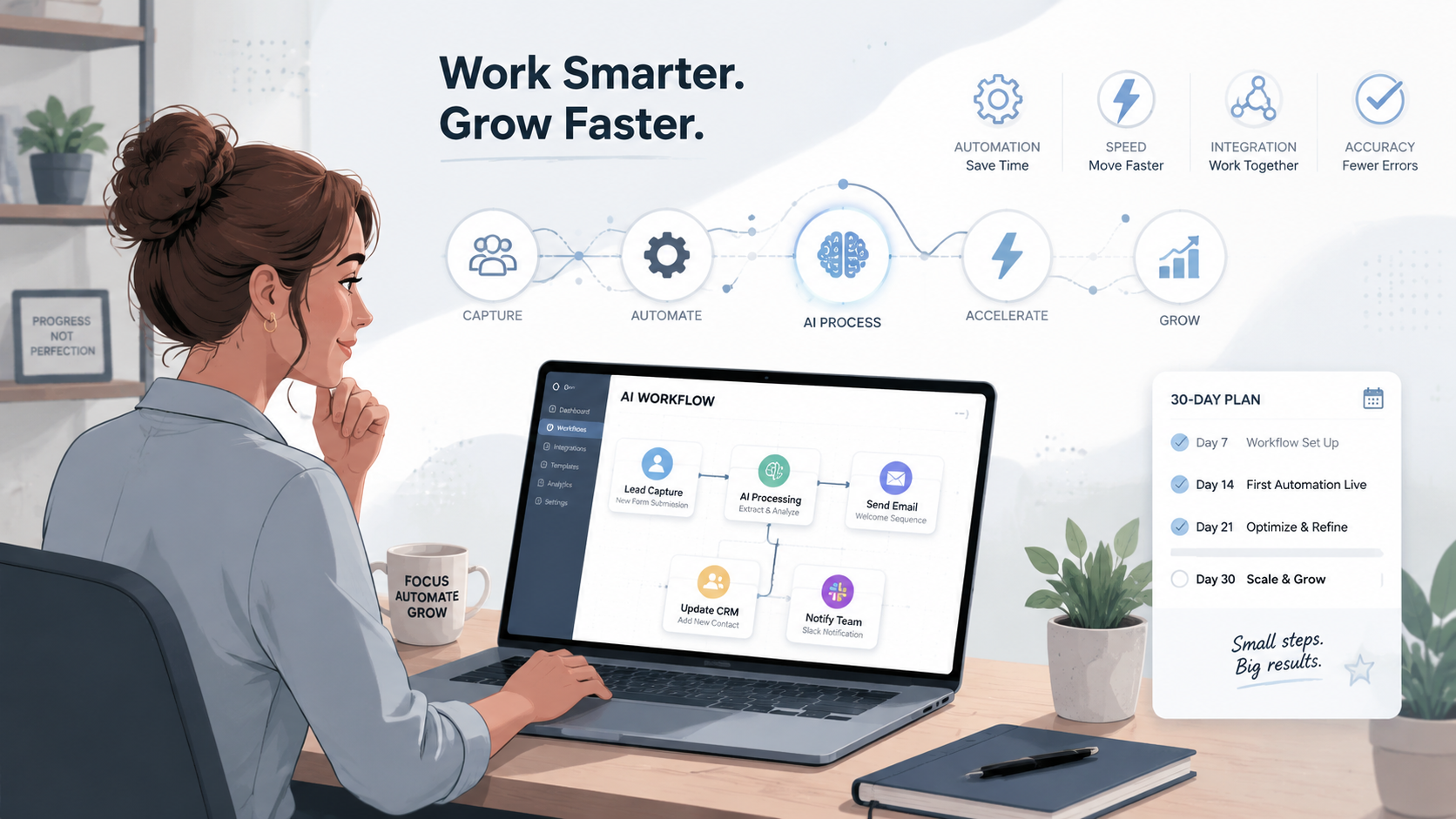
5 Agentic AI Workflows Small Businesses Can Launch in 30 Days Without a Tech Team
The marketing landscape is shifting. By 2026, successful business owners won’t just use AI—they’ll manage it like product managers. They’ll oversee autonomous workflows that handle lead enrichment, customer data, and campaign quality assurance without constant human intervention.
If that sounds intimidating, it doesn’t have to be. Agentic AI—the newest evolution in business automation—is now accessible to small and mid-sized businesses. Unlike traditional chatbots that respond to questions, agentic AI systems autonomously execute multi-step workflows, making decisions, processing data, and reporting results without you lifting a finger.
Here’s the good news: you don’t need a dedicated tech team to get started. In this guide, we’ll walk you through five high-impact agentic AI workflows you can deploy within 30 days, complete with human checkpoints to keep everything safe and accurate.
What is Agentic AI, and Why Does It Matter?
Let’s start with the fundamentals. Traditional AI tools—like chatbots or predictive analytics—are reactive. They wait for input and respond accordingly. Agentic AI is proactive. It’s autonomous software that observes your business environment, makes decisions based on rules you set, and takes action across multiple systems without waiting for approval at every step.
Think of it this way: a chatbot answers questions. An agentic AI system answers questions, logs the interaction, flags high-priority leads, enriches contact data, and sends notifications to your team—all in seconds.
This distinction matters because it fundamentally changes how your business operates. Instead of employees spending hours on repetitive data entry, sorting, and reporting, your team focuses on strategy, client relationships, and revenue-generating activities. The AI handles the operational backbone.
Why Summer 2026 is the Perfect Time to Launch
Summer is traditionally slower for many businesses. Traffic lightens. Your team has breathing room. Rather than letting that downtime slip away, it’s the ideal window to implement automation infrastructure that’ll power your autumn campaigns.
Additionally, agentic AI is a documented 2026 trend in digital marketing. Early adopters will differentiate themselves from competitors still relying on templates and manual processes. By launching now, you’re positioning your business as forward-thinking and operationally sophisticated—exactly the positioning that attracts better clients and retention.
The Five High-Impact Agentic AI Workflows for Small Businesses
1. Automated Lead Scoring and Segmentation
When leads arrive through your website, email campaigns, or ads, they land in a pile. Some are high-quality and ready for immediate sales outreach. Others need nurturing. Many are completely unqualified.
An agentic AI system watches your lead sources in real-time. It evaluates each new lead against criteria you define—industry, company size, engagement level, budget signals—and automatically assigns them to the right sales pipeline or nurture sequence. Within minutes, hot prospects are flagged for your team. Cold leads enter automated workflows. Middle-of-the-road leads get tagged for follow-up.
Result: Your sales team spends 70% less time sorting leads and 30% more time closing deals.
2. Real-Time Campaign Quality Assurance
Ad campaigns, email sequences, and landing pages go live daily in most businesses. But how do you know they’re performing correctly? Usually, you find out when performance tanks.
Agentic AI continuously monitors your active campaigns. It checks for broken links, missing tracking pixels, landing page load times, email deliverability issues, and conversion rate anomalies. The moment something slips below your quality threshold, the system alerts your team. Some systems can even pause underperforming ads or retry failed integrations automatically.
Result: Problems are caught within hours instead of days, saving thousands in wasted ad spend.
3. Post-Purchase Customer Data Tagging
When a customer completes a purchase, their profile should reflect their behavior instantly. They bought a premium package? Tag them as “high-value.” They abandoned a cart? Tag them as “at-risk.” They engaged with educational content? Tag them as “self-service learner.”
Agentic AI watches your e-commerce and CRM systems. When a transaction completes, the system automatically enriches customer records with relevant tags, updates their lifecycle stage, and enrolls them in appropriate follow-up sequences. Your email marketing, support team, and sales staff all see a unified, up-to-date customer profile within minutes.
Result: Personalization becomes automatic. Customers receive relevant communication without manual intervention.
4. Intelligent Customer Support Triage
Support inquiries are not all equal. Some require immediate human attention. Others can be resolved by automated systems or self-service resources.
An agentic AI system reads incoming support tickets, classifies them by urgency and category, and routes them accordingly. Billing questions get answered by pulling the correct database information. Technical issues get detailed documentation. Urgent complaints get flagged for immediate human response. The system learns from your team’s responses and improves its classification over time.
Result: Your support team handles urgent issues first. Routine problems resolve automatically. Average resolution time drops significantly.
5. Automated Reporting and Insights Generation
Creating weekly or monthly reports shouldn’t require hours of manual data compilation. An agentic AI system pulls metrics from all your business tools—Google Analytics, Facebook Ads, your CRM, email platform, and sales data—combines them into a unified view, and generates insights automatically.
Better yet, the system can identify anomalies, spot emerging trends, and flag opportunities for optimization without you asking. Your Monday morning report is ready before your coffee gets cold.
Result: You spend zero hours on data collection and have actionable insights delivered automatically.
Your 30-Day Implementation Roadmap
Week 1: Assessment and Selection
Audit your current processes. Which repetitive task consumes the most time? Which workflow has the highest error rate? Which process directly impacts revenue? Prioritize based on impact, not ease.
Select your first agentic AI workflow. We recommend starting with either lead scoring or campaign QA—both deliver immediate, measurable ROI.
Week 2: Configuration and Setup
Work with your vendor to configure the system. Define the rules, thresholds, and automation logic. Connect your existing tools—CRM, email platform, analytics—through secure APIs.
Establish your human checkpoints. Before the AI executes certain actions (like pausing a campaign), it should notify your team for final approval during this initial phase.
Week 3: Testing and Refinement
Run the system in test mode. Feed it sample data. Observe how it performs. Adjust rules based on results. Check output accuracy against your standards. This is your quality gate.
Involve a team member who understands the business domain. Their feedback is invaluable for refinement.
Week 4: Launch and Monitoring
Move to production. Monitor closely for the first week. Are results accurate? Are notifications going to the right people? Are integrations stable?
Maintain human checkpoints. As the system proves reliable, gradually reduce manual approvals. But never eliminate them entirely—always maintain oversight.
Why Managed Hosting Matters
Agentic AI systems require reliability. A few hours of downtime means thousands of leads go unscored, campaign issues go undetected, and reports don’t get generated.
Managed hosting ensures your AI infrastructure runs on redundant systems with automatic failover. Your workflows continue 24/7, even during updates or unexpected failures. This is why enterprise-grade managed hosting isn’t a luxury—it’s essential infrastructure for autonomous systems that run your business operations.
Positioning Your Business in 2026
The businesses that win in 2026 won’t be the ones with the most marketing budget. They’ll be the ones operating most efficiently. They’ll be the “internal influencers”—owners and leaders who’ve mastered the technology layer and can articulate their sophisticated operations to prospects and partners.
When you launch agentic AI workflows, you’re not just automating tasks. You’re building competitive moat. You’re proving that your business is operationally mature, data-driven, and serious about scalability. That positioning attracts better clients, commands premium pricing, and enables sustainable growth.
Ready to Launch?
Agentic AI isn’t a trend for large enterprises anymore. It’s accessible, implementable, and transformative for small and mid-sized businesses right now.
The question isn’t whether you should implement autonomous AI workflows. It’s whether you can afford not to. Your competitors aren’t waiting. The summer window is open. The technology is ready.
At DASAR Productions, we help serious business owners build sophisticated, automated marketing operations. We’ve guided dozens of small businesses through their first agentic AI implementations, and we’ve seen the impact firsthand—reduced costs, faster execution, better results.
If you’re ready to discuss how these workflows might apply to your specific business, let’s talk. Schedule a consultation with our team, and we’ll walk you through a customized 30-day roadmap tailored to your operations.
Your future self—the one running a more efficient, more profitable business—is waiting. The time to start is now.